In Grade 5, students learn that volume is the amount of space inside a 3D figure, measured by packing it with unit cubes with no gaps or overlaps.
A smart way to count: find how many cubes are in one layer (length × width), then multiply by the number of layers.
Official benchmarkExplore volume as an attribute of three-dimensional figures by packing them with unit cubes without gaps. Find the volume of a right rectangular prism with whole-number side lengths by counting unit cubes.
On the FAST test: part of the Grade 5 reporting category Geometric Reasoning, Measurement, and Data Analysis and Probability, which is about 23–29% of the test.
Worked Examples
Worked Example 1
Counting by Layers
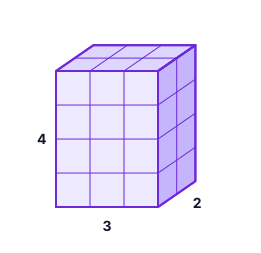
A box is 3 cubes long, 2 cubes wide, and 4 layers tall.
1One layer: 3 × 2 = 6 cubes.
24 layers: 6 × 4 = 24 cubes.
Answer: 24 cubic units
Worked Example 2
Filling a Box
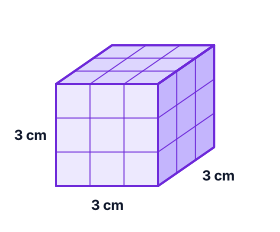
How many 1-cm cubes fill a box that is 3 cm by 3 cm by 3 cm?
1One layer: 3 × 3 = 9 cubes.
23 layers: 9 × 3 = 27 cubes.
Answer: 27 cubic centimeters
Common Mistakes to Watch For
Counting only the cubes you can see
Wrong:A 3 × 2 × 4 box has 18 cubes
Some cubes are hidden inside. Count by layers: 6 cubes per layer × 4 layers = 24.
Adding the dimensions
Wrong:3 + 2 + 4 = 9 cubes
Volume multiplies: 3 × 2 × 4 = 24 cubic units.
Helpful Math Tip
Build it with sugar cubes, LEGO bricks, or dice. Seeing the layers makes the "layer × number of layers" idea click.
Independent Educational Platform. FastChomp is published by Tropical Learning LLC and is not affiliated with, sponsored by, or endorsed by the Florida Department of Education. FAST and Star assessment names are referenced for informational purposes only. FastChomp practice questions are original educational materials, not official Florida FAST assessment questions.